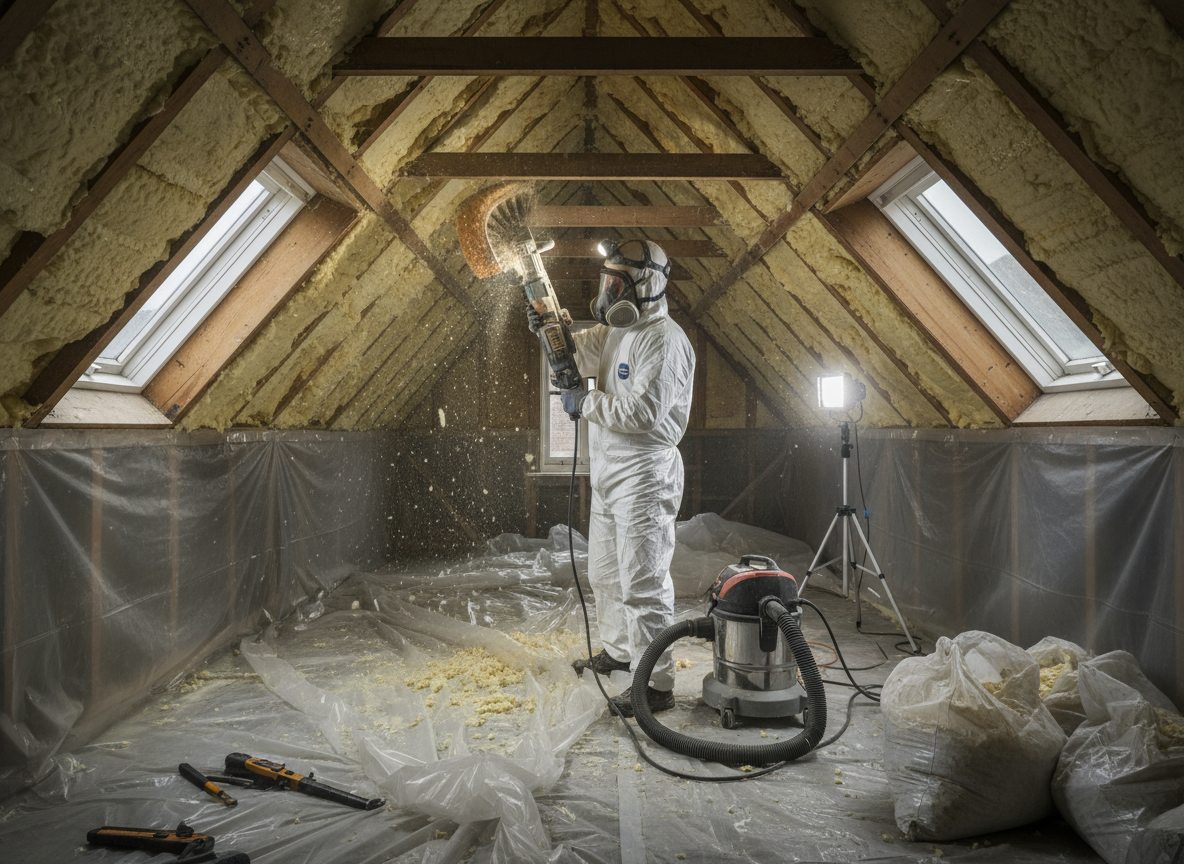
Bath's older housing stock, particularly Georgian terraces and Victorian semis around areas like Widcombe and Larkhall, often features narrow roof voids with limited access and original timber that can be easily damaged during foam extraction. Spray foam applied directly to rafters traps moisture against the wood, accelerating rot in the damp winters typical of the Avon valley. Removal requires careful cutting and vacuum extraction to avoid disturbing asbestos insulation common in mid-century ceilings or dislodging loose stonework in the chimneys that run through many attics here.
Homeowners in Bath frequently discover the foam was installed over existing mineral wool or between ceiling joists without proper ventilation channels, leading to condensation issues on the underside of the roof tiles. Safe removal involves sectioning the foam, using negative air machines to contain dust, and inspecting for underlying damp caused by blocked gutters on the steep pitched roofs common in the city centre. Any remaining adhesive must be neutralised before new insulation can be installed, otherwise it interferes with the breathability required for solid stone walls.
Edge cases include listed buildings where listed-building consent may be needed before disturbing original roof structures, and properties on the hillsides around Bathwick where access for equipment is restricted by narrow lanes. Technicians must also account for the high water table in lower-lying parts of the city that can push additional moisture into cellars and up through party walls, affecting how thoroughly the attic needs drying after foam removal.
Technician insight
In Bath, the thing that catches most people out with attic spray foam removal is how the foam was often sprayed right up against the stone party walls in terraces like those in Oldfield Park. The stone holds moisture differently than timber, so once the foam is gone you frequently find hidden damp that needs addressing before any new insulation goes back in.
Widcombe Terrace Attic
Homeowner noticed musty smell and ceiling staining in a Georgian terrace. Inspection showed closed-cell foam applied directly to rafters over existing lath and plaster. We sectioned and extracted the foam, discovered active rot along the ridge, then dried and treated the timber. The attic was left clear and ventilated with no further moisture issues.
How it works
- 1
Initial Inspection
Assess attic access, foam depth, and any hidden timber damage in the specific roof void.
- 2
Containment Setup
Install negative air and dust barriers to protect living spaces below.
- 3
Foam Sectioning and Extraction
Cut foam into manageable pieces and remove using industrial vacuums without scoring rafters.
- 4
Surface Cleaning and Drying
Neutralise residue and confirm the roof void is dry before handover.
- 5
Final Walkthrough
Review the cleared space and discuss next steps for re-insulation if required.
Pricing
Cost depends on attic size, foam thickness, and access difficulty in older Bath properties; quotes provided after inspection.