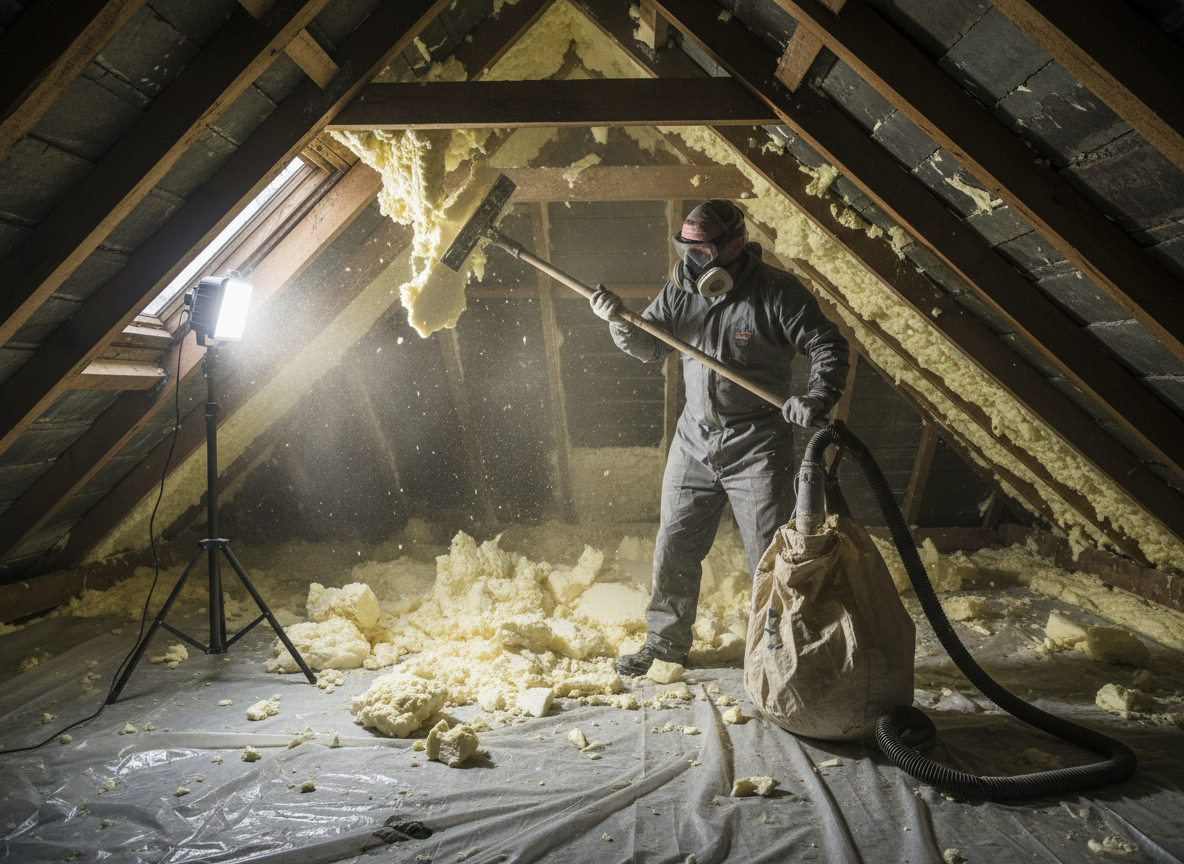
Bath's Georgian and Victorian terraces often received spray foam in lofts and under floors during the 2000s energy upgrades. The closed-cell product bonds tightly to Bath stone and lime mortar, trapping moisture that leads to rot in rafters and joists. Removal requires careful scoring and mechanical separation to avoid cracking the soft limestone that is common throughout the city centre and areas such as Walcot and Widcombe. Once the foam is gone, ventilation must be restored so the original breathable construction can dry out naturally.
Edge cases appear regularly in properties built before 1919 where foam was applied over original lath and plaster ceilings. The weight of the foam can pull ceilings down during extraction, so temporary propping and dust containment are essential. In the steeper valleys around Bath, cold air pools in winter and any remaining foam pockets hold condensation against timber, accelerating decay. Technicians check for hidden electrical cables and pipework that were covered during the original installation, because these are easily damaged when foam is cut away.
Local building control expectations in the Bath area require that any work exposing structural timber be recorded and that moisture levels are checked before new insulation is considered. Homeowners sometimes attempt DIY removal with chisels and heat guns, which releases isocyanates and leaves residue that later causes adhesion problems. Professional crews use negative-air machines and HEPA filtration to keep dust out of living spaces in tightly packed terraces where neighbours share party walls.
Seasonal Considerations for Bath Properties
Winter jobs in the Bath area often involve working in unheated lofts where temperatures drop quickly, making foam more brittle and easier to fracture cleanly. Summer work requires extra dust control because open windows in neighbouring homes can pull particles into adjacent properties along the narrow streets of the city centre.
Technician insight
In Bath, the thing that catches most people out with spray foam insulation removal is how quickly the foam pulls lime mortar out of the joints in Georgian stone walls when you try to lever it free; the soft stone and narrow streets mean you cannot just drop large sections without risking damage to the structure or the neighbour's roof.
Walcot Loft Extraction
Owner reported persistent damp smell in a 1820s terrace. Inspection showed closed-cell foam bonded to rafters and trapping condensation. Crew removed the foam in controlled sections, cleaned the stone and opened vents. The loft dried out and the musty odour disappeared.
How it works
- 1
Initial Inspection
Survey the property type, foam depth and condition of stone or timber substrates in Bath homes.
- 2
Containment Setup
Install dust barriers and negative air to protect shared walls common in Georgian terraces.
- 3
Foam Extraction
Score and mechanically remove foam in sections, preserving original lime mortar and rafters.
- 4
Substrate Cleaning and Drying
Remove residue and monitor moisture levels before any further works.
- 5
Final Ventilation Check
Confirm airflow is restored so the building can breathe as originally intended.
Pricing
Pricing depends on access, foam thickness and property age; quotes follow inspection.